

Sciatica has a way of making an ordinary day feel surprisingly complicated. A morning drive becomes uncomfortable because sitting makes your leg ache. You get up from your desk and wait a few seconds before taking that first step because you know there may be a sharp pull through your buttock. By evening, even relaxing on the sofa requires a little rearranging until you find the position your leg is willing to tolerate.
For some people, the pain is sharp and unmistakable. For others, it feels more like burning, tingling, numbness, or a deep ache that seems to travel. When these symptoms interfere with sleep, work, exercise, or everyday movement, acupuncture for sciatica may be considered as part of a broader, conservative treatment plan.
At Total Health Physical Medicine & Rehabilitation Center, care begins with understanding your symptoms, their possible cause, and their effect on your daily life. We provide personalized care to patients across New Jersey from our convenient locations in Berkeley Heights and Florham Park.
What Is Sciatica and Why Does It Travel Down the Leg?
Although people commonly say they “have sciatica,” sciatica is actually a term used to describe a particular collection of symptoms rather than a single disease.
The sciatic nerve is the largest nerve in the body. It is formed by nerve roots from the lower spine and travels through the buttock before continuing down the leg. When one of these nerve roots becomes compressed, inflamed, or irritated, symptoms can be felt along the nerve pathway.
This explains one of the stranger things about sciatica: your leg can hurt even though the underlying problem may be around your lower spine.
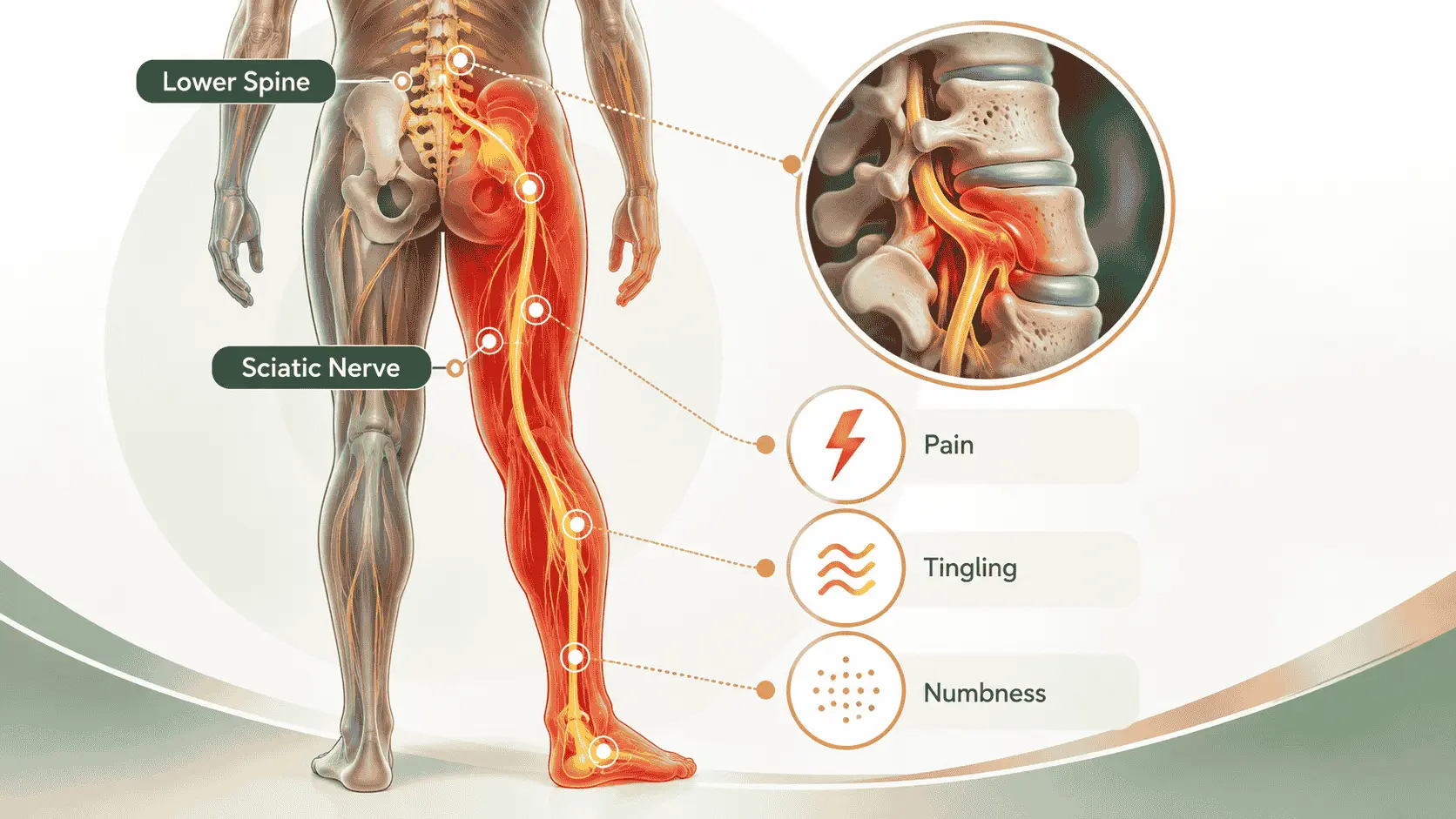
A herniated disc is one possible cause, but age-related changes and narrowing around the nerves can also contribute. Depending on the nerve involved and the severity of irritation, people may experience lower back pain, buttock, thigh, calf, or foot. Tingling, numbness, burning sensations, and muscle weakness can sometimes occur alongside the pain.
Understanding where the symptoms come from is important because effective treatment needs to consider more than simply the part of the leg that hurts.
Why Does Sciatica Feel So Different From Ordinary Back Pain?
A tired or strained back will often produce a fairly local ache. Nerve pain tends to have a different personality.
Someone with sciatica might describe a sudden electric sensation travelling down the leg when they bend forward. Another person may feel a constant burning through the buttock and thigh. Someone else may have relatively little pain but notice pins and needles in the foot after sitting for too long.
The symptoms can also change depending on position. Sitting may be particularly uncomfortable for one person while another notices symptoms when standing or walking. Even coughing or sneezing can sometimes aggravate pain when a spinal nerve root is irritated.
This unpredictable quality can make people nervous about movement. You begin remembering which movements hurt last time and unconsciously avoiding them, which is one reason sciatica care should consider both pain and the way pain has changed your movement.
What Is Acupuncture and Why Is It Used for Pain?
For someone who has never tried acupuncture, the word “needle” can make the treatment sound much more intimidating than it usually is.
Acupuncture for pain relief involves placing extremely fine needles at carefully selected points on the body. Unlike the hollow needles used for injections or blood tests, acupuncture needles are thin and typically cause little discomfort. Some patients may notice temporary warmth, tingling, heaviness, or a dull sensation during treatment.
Research suggests that acupuncture may affect nervous-system pathways involved in pain processing and modulation. For people with sciatica, it may help manage discomfort associated with nerve irritation, although it does not physically reposition a disc or remove the underlying cause.
You can learn more about acupuncture services at Total Health Physical Medicine & Rehabilitation Center.
Does Acupuncture Help With Sciatica?
This is naturally the question most people want answered before considering treatment, and research into acupuncture for sciatica pain has produced encouraging findings.
A 2024 randomized clinical trial published in JAMA Internal Medicine studied people with chronic sciatica caused by a herniated disc. Researchers found that participants receiving acupuncture experienced greater reductions in leg pain and improvements in disability than those receiving sham acupuncture. The differences emerged during the treatment period and were maintained through the study’s longer-term follow-up.
That does not mean everyone with sciatica will respond in the same way, nor does it mean acupuncture removes every underlying cause of sciatic nerve irritation. What it does suggest is that acupuncture may be a useful option for improving pain and function in some appropriately selected patients.
The distinction matters because the goal of treatment should never be to promise a quick “fix.” If a disc is irritating a nerve, for example, acupuncture does not simply put that disc back into place. Instead, it may help manage the pain while a broader treatment and rehabilitation plan addresses other factors involved in recovery.
What Are the Potential Benefits of Acupuncture for Sciatic Nerve Pain?
When pain has been present for a while, even modest improvements can begin changing the rhythm of everyday life.
Perhaps sitting through dinner becomes easier. You sleep for longer before your leg wakes you. The walk around the neighborhood no longer feels quite so intimidating. You are able to participate more comfortably in rehabilitation exercises that previously aggravated your symptoms.
This is why the potential benefits of acupuncture for sciatic nerve pain are not limited to what happens during the treatment session. If pain becomes more manageable, it may become easier for some patients to remain active and gradually rebuild strength, mobility, and confidence.

Pain reduction can therefore become a doorway to something bigger: getting back to movement.
Why Finding the Cause of Sciatica Still Matters
If two people walk into Total Health Physical Medicine & Rehabilitation Center with pain travelling down the right leg, it would be easy to assume they have the same problem. Their symptoms may sound almost identical, but the underlying reasons for those symptoms could be quite different.
One may have a lumbar disc herniation irritating a nerve root, while another may have age-related changes affecting the space available around a nerve. The duration and severity of symptoms can also vary enormously.
This is why asking “Does acupuncture help sciatica?” requires a thoughtful answer. Acupuncture may help manage symptoms for some people, but an appropriate evaluation should come first so that treatment is based on what is actually happening rather than on the word “sciatica” alone.
That evaluation also helps identify situations where another treatment approach or further medical investigation may be necessary.
Acupuncture Can Be One Part of a Bigger Recovery Plan
Recovery from sciatica does not have to revolve around finding one treatment and hoping it does everything.
Depending on the cause and severity of the condition, acupuncture may be combined with rehabilitation, therapeutic exercise, movement education, or other conservative treatments. Each part of the plan can have a different role, with acupuncture potentially helping manage pain while rehabilitation works on restoring strength, mobility, and everyday function.
This wider approach can be especially useful when someone has been living with sciatica for months. Persistent pain often changes the way people move. They may favour one leg, stop exercising, avoid bending, or become nervous about activities that once felt completely natural.
Good rehabilitation recognizes that recovery is not simply about making pain quieter. It is also about helping someone feel capable in their body again.
Is Acupuncture for Sciatica Suitable for Everyone?
Acupuncture can be a conservative option for many people, but that does not make it appropriate for every person experiencing sciatic pain.
The first step should always be understanding the symptoms and identifying anything that requires additional medical attention. Significant or worsening muscle weakness, loss of bladder or bowel control, numbness around the groin or saddle region, or rapidly progressing neurological symptoms should be assessed urgently.
There may also be individual health circumstances that affect whether or how acupuncture is provided. A careful medical history and assessment therefore remain important even when the treatment itself is considered relatively conservative.
The question is not simply, “Is acupuncture good for sciatica?” It is whether acupuncture makes sense for your particular presentation of sciatica.
Why Choose Total Health Physical Medicine & Rehabilitation Center?
By the time many people seek treatment for sciatica, they have become experts in avoiding their own pain. They know which chair is safest, which sleeping position causes the least trouble and exactly how long they can sit in the car before the familiar ache starts travelling down the leg.
Those details are important because they show how much the condition has begun shaping everyday life.
We look beyond the painful nerve to consider your symptoms, medical history, movement, daily activities, and personal goals.
For patients seeking acupuncture for sciatica in New Jersey, it may be included within a personalized treatment plan alongside chiropractic care, physical therapy, and other appropriate conservative treatment options.
If sciatica is affecting your comfort, mobility, or daily routine, you do not have to keep planning your life around the pain. Book an appointment at our Berkeley Heights or Florham Park location to have your symptoms evaluated and discuss the treatment options that may support your recovery.

FAQs
Does acupuncture help sciatica?
Research suggests acupuncture may help reduce pain and improve function in some people with sciatica. Individual results vary, and suitability depends on factors including the cause and severity of the symptoms.
How does acupuncture for sciatica pain work?
Acupuncture uses very fine needles at selected points on the body. Research suggests the stimulation produced by acupuncture may influence nervous system pathways involved in how pain is processed and modulated.
How many acupuncture sessions might I need for sciatica?
There is no standard number that is right for everyone. The recommended course can depend on how long you have experienced symptoms, their severity, the underlying cause, and how you respond to treatment.
Can acupuncture cure sciatica caused by a herniated disc?
Acupuncture should not be considered a method of physically reversing a herniated disc. It may help some patients manage pain and improve function, while treatment of the underlying condition may involve additional approaches.
When should sciatica be treated as an emergency?
Seek prompt medical attention if sciatic symptoms are accompanied by significant or rapidly worsening weakness, loss of bladder or bowel control, numbness around the groin or saddle area, or other serious neurological changes.
Disclaimer: This article is intended for educational purposes only and does not replace professional medical advice, diagnosis, or treatment.


