

Your feet are remarkably good at being ignored.
They carry you through thousands of steps, adjust to uneven ground, tell you whether the bathroom floor is freezing, and somehow find the corner of the bedframe in the dark. Most days, you barely think about them.
Until they start feeling different.
Maybe there is a faint fizzing sensation in your toes while you are watching television. Perhaps one foot keeps falling asleep for no obvious reason. You take your socks off because something feels bunched underneath them, only to discover there is nothing there.
Then a few weeks later, it happens again.
Tingling in the feet, numbness in the feet, burning, unusual sensitivity, or changes in sensation can sometimes be early signs of peripheral neuropathy. And because neuropathy often develops gradually, those small changes are worth paying attention to.
At Total Health Physical Medicine & Rehabilitation Center, understanding the pattern behind those symptoms is an important part of determining what may be affecting your nerves and what can be done next.
First, What exactly is Neuropathy?
Your nerves are essentially your body’s communication system.
The peripheral nerves extend beyond the brain and spinal cord, carrying information back and forth between your central nervous system and the rest of your body. Some help you feel touch, temperature, and pain. Others control muscles or influence automatic functions within the body.
When peripheral nerves become damaged or stop functioning normally, those messages can become distorted.
A light touch might suddenly feel unpleasant. Your toes may feel numb even though nothing is pressing on them. You might experience pins and needles, burning, shooting sensations, or weakness.
That collection of problems is known as peripheral neuropathy.
Importantly, neuropathy is not one single disease. It can have many different causes, which is why recognizing the symptoms is only the beginning of the investigation.
Why Does Neuropathy Often Show Up in the Feet First?
There is a reason the toes are often the first place people notice something strange.
Many common forms of peripheral neuropathy are described as “length-dependent.” In simple terms, the longest peripheral nerves can be particularly vulnerable, and some of those nerves have a very long journey from the spinal cord all the way down to your feet.
Symptoms may therefore begin at the tips of the toes before gradually moving further across the feet and, in some cases, upward into the legs.
It can be surprisingly subtle.
One person may describe a burning sensation inside the foot. Another says their feet feel cold even though they are warm to touch. Someone else may notice that the carpet beneath their toes doesn’t feel quite as distinct as it once did.
Neuropathy does not always announce itself with severe pain. Sometimes it whispers first.
What Are the Early Signs of Neuropathy in Your Feet?
The earliest symptoms can vary considerably from person to person but there are several changes worth noticing.
Tingling or pins and needles may appear intermittently at first. You might notice it particularly at night or when sitting quietly.
Numbness can make the feet feel strangely heavy, padded, or disconnected from the ground.
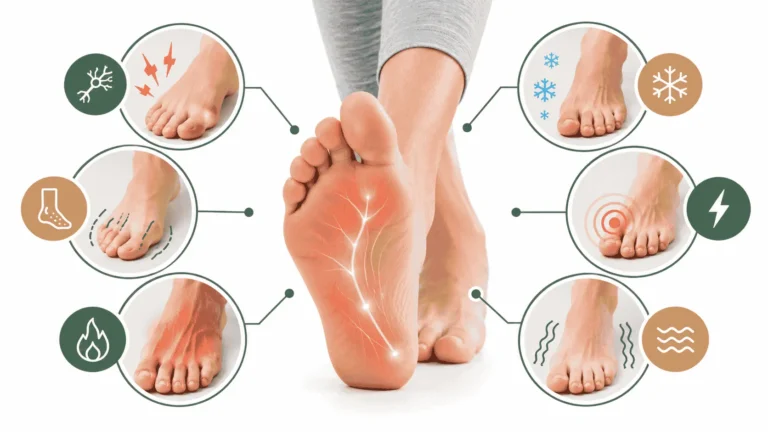
Burning sensations may range from mild warmth to intense discomfort. Some people find that even bedsheets touching their feet become uncomfortable.
There can also be increased sensitivity, shooting or electric-like pain, changes in balance, muscle weakness, or difficulty detecting temperature.
What matters isn’t only what you feel. Pay attention to whether the sensation keeps returning, whether it is spreading, and whether it is beginning to change how you walk, sleep, exercise, or manage everyday activities.
Can You Have Neuropathy Without Diabetes?
Absolutely, and this is an important misconception to clear up.
Diabetes is one of the best-known causes of peripheral neuropathy, but it is far from the only one.
So, can you have neuropathy without diabetes? Yes.
Neuropathy may be associated with vitamin deficiencies, certain autoimmune or metabolic conditions, kidney disease, alcohol use, infections, some medications and chemotherapy treatments, inherited disorders, physical injury, or compression of a nerve.
And sometimes, even after investigation, a clear cause isn’t identified. This is known as idiopathic neuropathy.
That is precisely why persistent tingling shouldn’t automatically be labelled “diabetic neuropathy” or dismissed because you don’t have diabetes.
The symptoms tell us that something may be happening with the nerves. They don’t necessarily tell us why.
What Are the Stages of Neuropathy in the Feet?
People often search for the stages of neuropathy hoping there is a simple Stage 1, Stage 2, Stage 3 progression.
Real life is not quite so tidy.
There isn’t one universally applicable staging system covering every cause and type of peripheral neuropathy. However, symptoms can progress over time in some people.
Early changes may begin with occasional tingling, unusual sensations, or mild numbness. As nerve dysfunction progresses, symptoms may become more frequent or spread further across the feet. Some people develop more noticeable burning or pain, while others actually experience less sensation as nerve damage advances.
That last point can be deceptive.
A foot becoming less painful doesn’t necessarily mean the nerves are getting better if sensation is also being lost.
More advanced nerve dysfunction can affect balance, coordination, muscle strength, and the ability to detect injuries to the feet.
This is one reason waiting for symptoms to become “bad enough” isn’t always the best strategy.
Can Neuropathy Go Away on Its Own?
Treatment may involve addressing an underlying condition, reviewing nutrition or medications, protecting the feet, and finding safe ways to remain active as part of a broader rehabilitation therapy plan. For some patients, Neurolumen Therapy may be incorporated as well.
For those looking for neuropathy treatment in New Jersey, Total Health Physical Medicine & Rehabilitation Center sees patients at both the Florham Park and Berkeley Heights locations, so care is available close to home from whichever part of Northern New Jersey you are located.
What Can Be Done About Neuropathy?
Treatment begins with understanding what is causing the nerve problem whenever possible.
That may mean addressing an underlying medical condition, reviewing nutritional factors or medications, managing diabetes appropriately, protecting the feet, and finding safe ways to remain active.
Treatment may also focus on pain, mobility, balance, strength, and function.
At Total Health Physical Medicine & Rehabilitation Center, neuropathy care considers how symptoms are affecting the individual rather than focusing only on a label.
For some patients, Neurolumen Therapy may also be incorporated into a broader treatment plan. Neurolumen is a non-surgical therapy used at the clinic for patients experiencing certain nerve-related symptoms, with treatment recommended following an appropriate evaluation. Stimpod Therapy may also be considered for certain patients, using targeted electrical stimulation to interact with affected nerves and support the management of neuropathic pain and nerve-related symptoms. Both therapies can be incorporated into a personalised care plan based on the individual’s symptoms and needs.
You can read more about our Neurolumen Therapy services here and learn how it may fit into an individualized approach to neuropathy care.
Don’t let neuropathy symptoms hold you back. Schedule an evaluation with our team today and find out if Neurolumen Therapy or another personalized treatment plan is right for you.

FAQs
What are the first signs of neuropathy in your feet?
Early symptoms may include tingling, pins and needles, numbness, burning, unusual sensitivity, or subtle changes in how temperature and touch feel. Symptoms often begin in the toes.
Can you have neuropathy without diabetes?
Yes. Diabetes is a common cause, but peripheral neuropathy can also be associated with vitamin deficiencies, certain medications, autoimmune and metabolic conditions, infections, alcohol use, inherited disorders, injuries, and other causes.
Does neuropathy always cause pain?
No. Some people experience significant burning or shooting pain, while others primarily notice numbness or reduced sensation. Neuropathy can also affect strength, balance, and coordination.
Can neuropathy go away on its own?
It depends on the underlying cause. Some temporary forms of nerve irritation can improve, while other neuropathies may be persistent or progressive. Recurring or worsening symptoms should be professionally evaluated rather than simply watched indefinitely.
When should I get tingling or numbness in my feet checked?
Seek an evaluation if symptoms persist, repeatedly return, spread, or begin affecting walking, balance, sleep, or everyday activities. New weakness or rapidly worsening neurological symptoms warrant prompt medical attention.
Disclaimer
This article is intended for educational purposes only and is not a substitute for professional medical advice, diagnosis, or treatment. Peripheral neuropathy can have many different causes, and treatment should be based on an appropriate medical evaluation. Seek prompt medical attention for rapidly worsening numbness or weakness, sudden neurological changes, significant balance problems, or foot wounds that are not healing.


