

When your back has been hurting for weeks or months, one of the first things you want from any treatment is a timeline. You want to know when sitting might become easier, when you can get through a workday without constantly changing position, or when you might stop thinking about your back every time you bend down to put on your shoes.
So, if you are considering spinal decompression, it is completely understandable to ask: How many spinal decompression sessions will I need?
The frustrating answer is that there is no magic number that applies to everyone. Someone dealing with a recent disc problem may have very different needs from someone who has lived with chronic lower back pain for years. Your diagnosis, symptoms, general health, response to treatment, and rehabilitation goals can all influence how a course of care is planned.
At Total Health Physical Medicine & Rehabilitation Center, spinal decompression is recommended following an appropriate evaluation, so the number of sessions is based on the person in front of us rather than a standard package applied to every back problem.
First, What Does Spinal Decompression Do?
To understand why the number of sessions can vary, it helps to understand what spinal decompression is designed to do.
Non surgical spinal decompression therapy uses a specialized table to apply controlled traction to the spine. The aim is to gently change forces within and around the spinal structures, which may help certain patients with disc-related or mechanical back and neck problems.
You can think of it less as a dramatic “stretch” and more as a carefully controlled treatment. The amount and pattern of traction can be adjusted according to the area being treated and the individual patient’s needs.
People may explore lower back decompression for conditions involving the lumbar spine, while others may receive treatment for appropriate neck-related problems. However, not every painful back needs decompression, which is why determining what is actually causing the symptoms matters first.
You can read more about our Spinal Decompression Therapy services.
So, How Many Spinal Decompression Sessions Might You Need?
There is no universally recommended number of spinal decompression sessions that is right for every patient. Treatment plans are usually developed according to the condition being treated, how long symptoms have been present, their severity, and how the patient responds as treatment progresses.
Some treatment protocols involve multiple sessions delivered over several weeks rather than one or two isolated appointments. That does not mean every patient automatically needs a long course of treatment. Regular reassessment is important because the plan should respond to what is actually happening rather than simply continuing because a predetermined number was written down at the beginning.
The more useful question may therefore be: Is treatment helping me do more?
Perhaps you can sit for longer without symptoms travelling into your leg. Maybe getting out of bed feels easier, or you are gradually returning to activities that you had started avoiding. Changes in pain matter, but so do changes in movement, sleep, work, exercise, and everyday function.
Why Might One Person Need More Sessions Than Another?
Back pain can look remarkably similar from the outside while having very different causes underneath.
Imagine two people who both arrive complaining of lower back pain and discomfort travelling into a leg. One has symptoms that began relatively recently following a disc problem, while the other has experienced recurring pain for several years alongside degenerative changes in the spine. Their symptoms may sound similar in conversation, but their treatment needs are unlikely to be identical.
This is why a decompression treatment plan should begin with an appropriate assessment. Your provider may consider your diagnosis, medical history, symptom pattern, imaging when clinically appropriate, neurological symptoms, previous treatments, and the movements that make you feel better or worse.
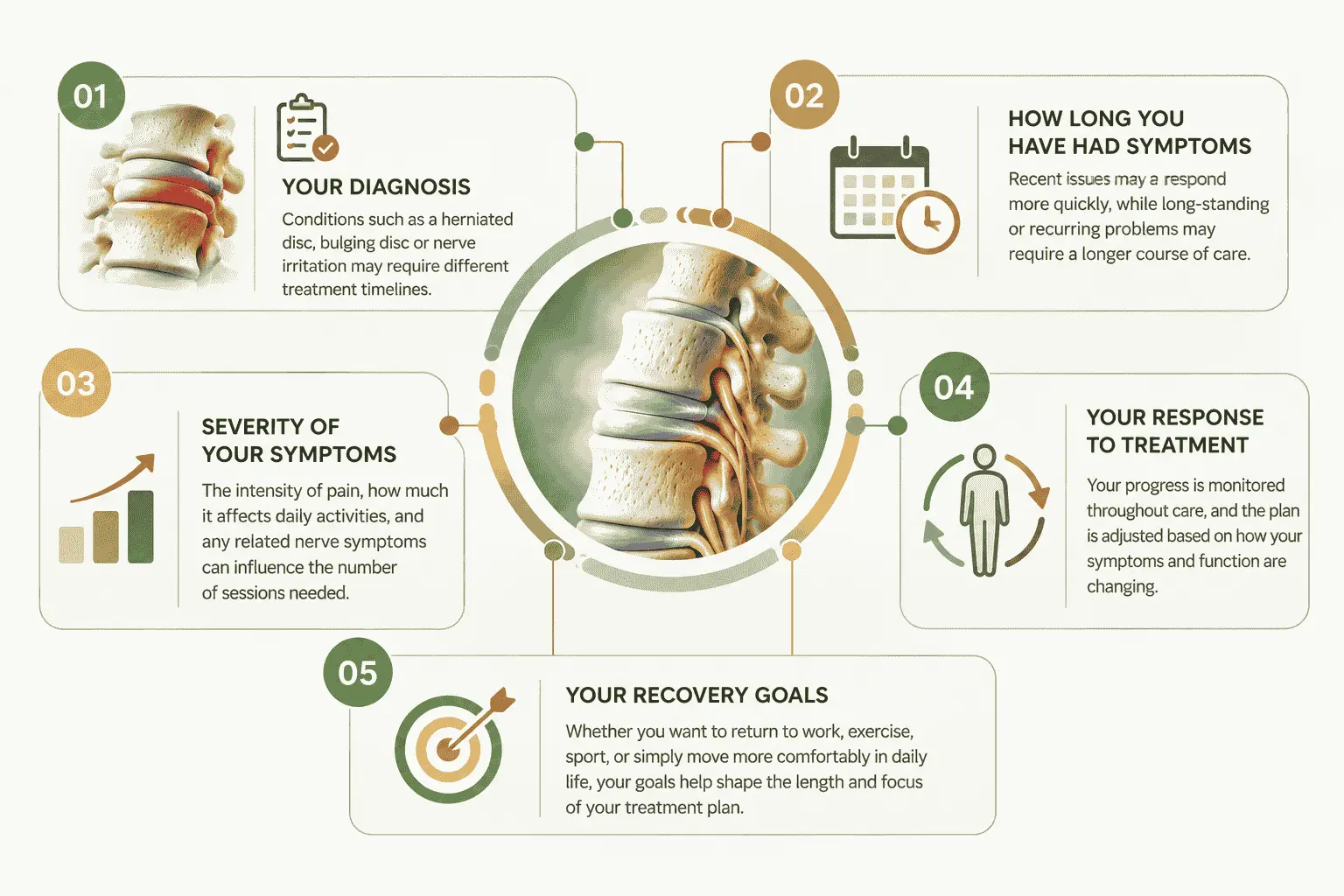
Your response during the course of treatment matters too. If symptoms are changing, the plan can be reassessed accordingly. If they are not improving as expected, that information is equally important because it may indicate that the treatment approach needs to be reconsidered.
What Conditions May Lead Someone to Consider Spinal Decompression?
Spinal decompression is often discussed in relation to certain disc and spine-related conditions, including herniated or bulging discs and some presentations involving nerve irritation. Whether it is suitable depends on the individual diagnosis and health history.
This is particularly important when someone searches online for “spinal decompression therapy near me” or “spinal compression treatment” and assumes that decompression is appropriate simply because they have back pain. Back pain can arise from muscles, joints, discs, nerves, inflammatory conditions, injuries, and other causes, and those problems do not all respond to the same treatment.
At Total Health Physical Medicine & Rehabilitation Center, the aim is to understand what may be generating the symptoms before deciding whether spinal decompression belongs in the treatment plan.
Is Spinal Decompression the Same as Chiropractic Decompression?
The terminology can sometimes become confusing because patients may encounter phrases such as chiropractic decompression, traction, or non surgical spinal decompression when researching their options.
There can be overlap in the broader goal of reducing mechanical stress on certain spinal structures, but the techniques and equipment used can differ. Non surgical spinal decompression typically involves a specialized motorized table that delivers controlled traction according to specific treatment parameters.
This is another reason it is useful to ask exactly what treatment is being recommended, why it has been recommended for your condition, and what role it is expected to play within your overall care.
What About Spinal Decompression Therapy Side Effects and Cons?
No treatment should be discussed only in terms of potential benefits. If you are researching spinal decompression therapy cons or possible spinal decompression therapy side effects, those are reasonable questions to bring to your provider.
Some people may experience temporary soreness or discomfort following traction-based treatment. More importantly, spinal decompression is not appropriate for every medical condition or every patient, and individual risk factors need to be considered before beginning care.
This is why an evaluation matters. A good treatment plan should not simply answer, “Can we perform decompression?” It should answer the more important question: “Is decompression appropriate for this particular person?”
Spinal Decompression Works Best as Part of a Bigger Picture
There is something appealing about finding one treatment that will solve a back problem on its own, but bodies rarely work that neatly.
For some patients, spinal decompression may be one part of a broader rehabilitation plan that also considers mobility, strength, movement habits, and the activities that matter most to them. Reducing discomfort can be valuable, but long-term progress may also involve helping someone become more confident using their back again.
That might mean being able to sit comfortably through a meeting, return to the gym, pick up a grandchild, walk further, or simply get through an ordinary day without constantly negotiating with lower back pain.
For people exploring Spinal Decompression Therapy in New Jersey, looking at those functional goals can make the treatment plan far more meaningful than focusing only on the number of appointments.
Experienced Spinal Decompression Care in New Jersey
At Total Health Physical Medicine & Rehabilitation Center, Dr. Todd Tyminski and Dr. Kelly BeShaw see patients for spinal decompression and bring extensive experience to evaluating spine-related problems and determining when this type of treatment may be appropriate.
Rather than assuming that everyone who walks through the door with back pain needs the same number of sessions, care is shaped around the individual’s condition, response, and goals. For patients searching for pain management in New Jersey, that means the conversation can begin with understanding what is happening and then deciding whether spinal decompression has a useful role to play.
If persistent back or neck pain has started changing how you work, sleep, exercise, or move through everyday life, you can book an appointment with Total Health Physical Medicine & Rehabilitation Center to discuss your symptoms and whether spinal decompression may be suitable for you.

FAQs
How many spinal decompression sessions do most people need?
There is no single number appropriate for everyone. Treatment plans can involve multiple sessions over several weeks, but the frequency and duration should depend on the diagnosis, severity of symptoms, individual health factors, and response to treatment.
What does spinal decompression do for a herniated disc?
Non surgical spinal decompression uses controlled traction to alter mechanical forces on the spine. It may be considered for certain patients with disc-related symptoms, but suitability should be determined after an appropriate evaluation.
How quickly will I know if spinal decompression is helping?
Response varies between patients. Rather than judging treatment only by pain intensity, your provider may also consider changes in mobility, radiating symptoms, sleep, activity tolerance, and everyday function.
Are there any spinal decompression therapy side effects?
Some patients may experience temporary soreness or discomfort. Spinal decompression is also unsuitable for certain conditions, which is why your medical history and individual risk factors should be reviewed before treatment begins.
Where can I receive Spinal Decompression Therapy in New Jersey?
Total Health Physical Medicine & Rehabilitation Center provides spinal decompression for appropriate patients following an evaluation. Dr. Todd Tyminski and Dr. Kelly BeShaw see patients for spinal decompression and can determine whether it may be suitable for your particular condition.
Disclaimer
This article is intended for educational purposes only and is not a substitute for professional medical advice, diagnosis, or treatment.


