

Your ankle does a remarkable amount of work without asking for much attention. Until one morning, those first few steps feel uncomfortable, or a familiar walk suddenly brings a sharp ache along the inside of your foot.
Pain inside the ankle can develop for several reasons, from irritated tendons to joint problems and previous injuries. At Total Health Physical Medicine & Rehabilitation Center, understanding what is causing the discomfort is the first step towards helping you move comfortably again.
First, Why Does the Inside of Your Ankle Hurt?
Your ankle is more than a simple joint connecting your foot to your leg. It is a busy network of bones, ligaments, tendons, cartilage, and nerves working together to support your weight and maintain balance.
The inner side of the ankle, known as the medial ankle, contains structures that help stabilise your foot and control movement.
When one of these structures becomes irritated or injured, you may notice swelling, stiffness, tenderness, or discomfort when walking.
Interestingly, inner ankle pain and outer ankle pain can have different causes. Outer ankle discomfort, sometimes called lateral ankle pain, frequently involves structures affected by rolling the ankle outwards, while pain on the inside may involve the posterior tibial tendon, deltoid ligament, or ankle joint itself.
Understanding where your ankle hurts provides useful clues, although location alone cannot confirm the diagnosis.
5 Common Causes of Pain Inside the Ankle
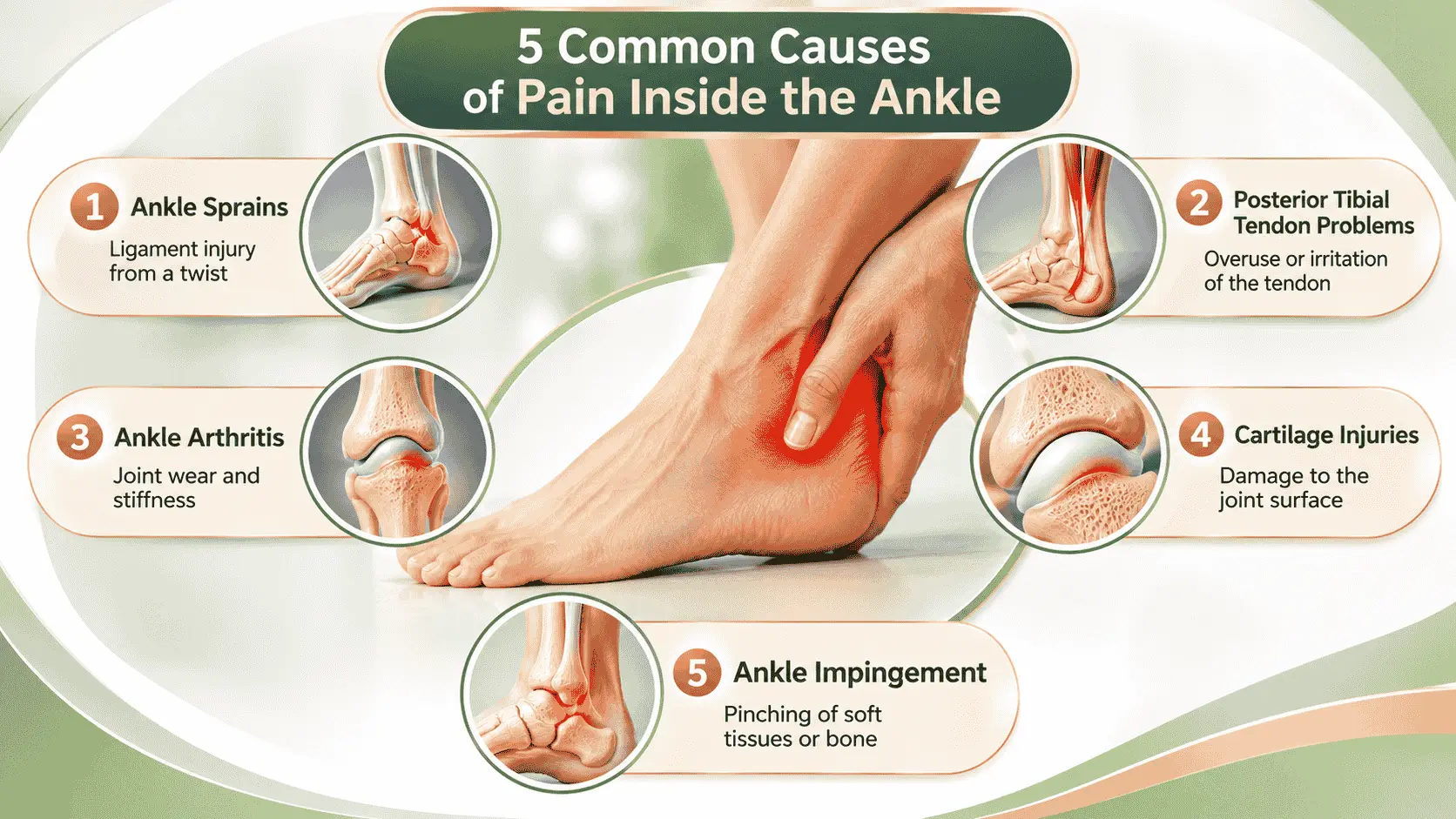
1. Ankle Sprains: When a Small Twist Causes a Big Problem
You step off a kerb awkwardly, your ankle rolls, and for a moment you wonder whether you can simply walk it off.
An ankle sprain happens when ligaments supporting the joint become overstretched or torn. Although outer ankle sprains are more common, the ligaments on the inner side can also be injured.
A painful inner ankle following a twist may be accompanied by swelling, bruising, tenderness, or difficulty putting weight on the foot.
Treatment depends on severity and may involve temporary support, activity modification, and rehabilitation to restore strength and stability.
2. Posterior Tibial Tendon Problems: The Overworked Support System
One of the most important structures along the inner ankle is the posterior tibial tendon. It travels behind the inner ankle bone and helps support the arch of your foot.
When this tendon becomes irritated or dysfunctional, discomfort may develop along the inside of the ankle and towards the arch.
You might notice that your inner ankle hurts after longer walks, standing for extended periods, or climbing stairs.
Some people also experience changes in their foot arch over time.
Appropriate footwear, supportive devices, activity adjustments, and strengthening exercises may form part of treatment.
3. Ankle Arthritis: When the Joint Becomes Less Cooperative
Sometimes ankle pain does not begin with a dramatic injury. Instead, the joint gradually becomes stiffer, particularly after resting or during longer periods of activity.
Arthritis involves changes within the joint that can contribute to pain, swelling, and reduced movement.
Previous ankle injuries can increase the likelihood of developing post-traumatic arthritis, even years after the original incident.
Treatment may involve activity modification, rehabilitation, appropriate footwear, and other measures to manage symptoms and preserve mobility.
4. Cartilage Injuries: When the Joint Surface Is Affected
The ankle joint contains smooth cartilage that helps the bones move comfortably against one another.
An osteochondral lesion occurs when a small area of cartilage and the underlying bone becomes damaged, sometimes following an ankle injury.
Symptoms may include deep ankle pain, swelling, catching, or discomfort that persists long after an apparent sprain has improved.
These injuries are not always obvious from the outside. Imaging and specialist assessment may be needed to understand the extent of the problem.
5. Ankle Impingement: When Movement Feels Pinched
Have you ever bent your ankle and felt as though something inside the joint was getting caught?
Ankle impingement occurs when soft tissues or bony structures become compressed during particular movements.
It can develop following repeated ankle injuries or ongoing irritation and may cause pain, stiffness, or a pinching sensation.
Treatment depends on the underlying cause and may include rehabilitation, movement modifications, or specialist care when symptoms persist.
What Can Your Ankle Pain Tell You?
Two people can point to almost exactly the same painful spot and have completely different problems.
One may have tendon irritation after increasing their walking distance, while another may be experiencing joint stiffness associated with arthritis.
Paying attention to when symptoms appear can provide helpful information. Does your ankle hurt first thing in the morning? Does discomfort increase after exercise? Is there swelling, instability, or a history of injury?
These details help clinicians understand which structures may be involved and whether further investigation is needed.
What Treatment Options Can Help Inner Ankle Pain?
The right treatment depends on the cause, severity, and how your symptoms affect everyday movement.
At Total Health Physical Medicine & Rehabilitation Center, several services may be considered for appropriate musculoskeletal conditions.
Chiropractic Care may help selected patients experiencing mechanical joint or movement-related problems. You can read more about our Chiropractic Care services.
Rehabilitation Therapy can be particularly valuable when ankle pain affects strength, balance, or stability. Exercises may help restore movement and gradually prepare the ankle for everyday activities. You can read more about our Rehabilitation Therapy services.
Shockwave Therapy may be considered for certain persistent tendon-related conditions, depending on the diagnosis. It is not appropriate for every ankle injury or joint problem. You can explore our Shockwave Therapy services here.
Acupuncture may also be incorporated into a broader pain-management plan for selected patients experiencing musculoskeletal discomfort. You can read more about our Acupuncture services here.
The important thing is that treatment should be chosen because it fits the condition, not simply because the ankle hurts.
When Should Ankle Pain Be Checked?
An occasional ache after an unusually active day may improve with rest and sensible activity adjustments.
However, persistent pain, recurring swelling, difficulty walking, or a feeling that the ankle may give way deserves professional assessment.
Seek prompt medical attention if you cannot bear weight following an injury, notice significant deformity, develop a hot swollen joint with fever, or experience severe or rapidly worsening symptoms.
Ankle Pain Treatment in New Jersey: Helping You Find Your Feet Again
Ankle pain has a way of changing your relationship with everyday movement. You start choosing shorter routes, avoiding uneven ground, or thinking twice before joining an activity you would normally enjoy.
At Total Health Physical Medicine & Rehabilitation Center, the focus is on understanding why those changes are happening.
For patients seeking ankle pain treatment in New Jersey, the team can evaluate musculoskeletal symptoms, assess movement and function, and discuss whether rehabilitation, chiropractic care, acupuncture, Shockwave Therapy, or another appropriate approach may help.
The goal is not simply to make your ankle feel better while you are resting. It is to help you work towards walking confidently, enjoying longer outings, and returning to the activities that make your days feel normal.
If ankle discomfort has started deciding how far you walk or what you feel comfortable doing, you can book an appointment with Total Health Physical Medicine & Rehabilitation Center to have your symptoms evaluated and explore appropriate treatment options.
FAQs
What is the most common cause of pain inside the ankle?
Posterior tibial tendon problems, ligament injuries, and arthritis are among the possible causes. The most likely explanation depends on your symptoms, activity history, and examination findings.
Why does my inner ankle hurt when I walk?
Walking places repeated demands on the ankle’s tendons, ligaments, and joints. Tendon irritation, ligament injuries, arthritis, and other conditions may become more noticeable during weight-bearing activity.
Is inner ankle pain different from outer ankle pain?
Yes. Pain on the inner and outer sides of the ankle can involve different structures. Outer ankle pain frequently involves lateral ligaments or tendons, while inner ankle discomfort may involve the posterior tibial tendon, deltoid ligament, or joint.
Can ankle pain improve without surgery?
Many ankle conditions can improve with appropriate conservative care, including activity modification, supportive footwear, rehabilitation, and other treatments. However, certain injuries require specialist evaluation or surgical management.
Where can I find ankle pain treatment in New Jersey?
Total Health Physical Medicine & Rehabilitation Center provides assessment and conservative treatment options for appropriate musculoskeletal ankle conditions at its Berkeley Heights and Florham Park locations.
Disclaimer
This article is intended for educational purposes only and does not replace professional medical advice, diagnosis, or treatment.


