

You wake up in the middle of the night, and your hand feels strangely unfamiliar. Perhaps your fingers are tingling, your palm feels heavy, or you need to shake your hand before the sensation returns. It is easy to blame the way you slept, but what if it keeps happening?
When your hands go numb while sleeping, the explanation can range from temporary nerve pressure to an underlying condition that deserves attention.
At Total Health Physical Medicine & Rehabilitation Center, understanding where the numbness begins is an important step towards finding appropriate care.
First, Why Do Your Hands Go Numb While Sleeping?
Your hands rely on an intricate network of nerves travelling from your neck, through your shoulders and arms, and into your fingers. These nerves carry messages that allow you to feel temperature, recognise touch, and control movement.
When a nerve becomes compressed or irritated, those messages can be disrupted. You may experience tingling, numbness, burning, or the familiar pins-and-needles sensation.
During sleep, your position can place pressure on certain nerves. Bending your wrist tightly, sleeping with your elbow folded, or resting your body weight on an arm may temporarily affect nerve function.
If the sensation disappears quickly after changing position, it may simply be related to temporary compression. However, recurring hand numbness can sometimes indicate a more persistent problem.
What Causes Numbness in Hands at Night?
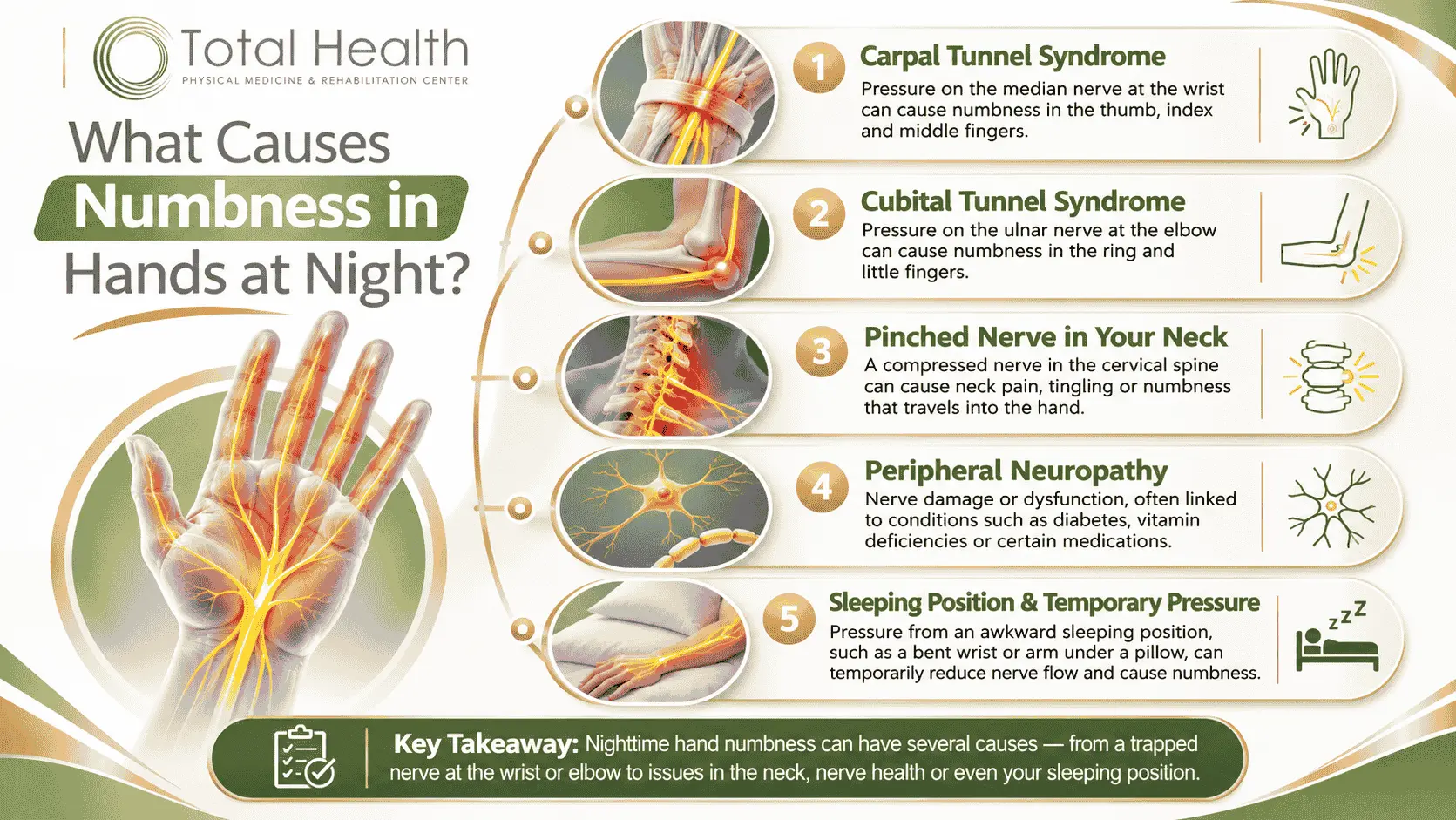
1. Carpal Tunnel Syndrome: When Your Wrist Needs Attention
Carpal tunnel syndrome is one of the common reasons people experience nighttime finger numbness.
The median nerve travels through a narrow passage in your wrist called the carpal tunnel. When pressure increases within this space, the nerve can become irritated.
You may notice tingling or numbness in your thumb, index finger, middle finger, and part of your ring finger. Symptoms frequently become more noticeable during sleep.
Some people wake up needing to shake their hands, while others notice difficulty gripping objects during the day.
Treatment may include nighttime wrist splinting, activity adjustments, and further medical evaluation when symptoms persist.
2. Cubital Tunnel Syndrome: The Problem May Be at Your Elbow
If your little finger and ring finger become numb, the source may be closer to your elbow.
The ulnar nerve passes through a narrow area around the inner elbow. Keeping your elbow bent for long periods, particularly while sleeping, can increase pressure on this nerve.
This is why some people notice their fingers going numb after sleeping with their hands tucked beneath their head.
Changing sleeping positions and avoiding prolonged elbow bending may help mild symptoms. Persistent numbness or hand weakness requires assessment.
3. A Pinched Nerve in Your Neck
Sometimes the hand is where you feel the problem, but the irritation begins much higher up.
Nerves leaving the cervical spine travel into the shoulders, arms, and hands. When a nerve root becomes irritated or compressed, it can cause symptoms known as cervical radiculopathy.
You may experience neck discomfort, pain travelling into an arm, tingling, or numbness in the tips of the fingers.
For selected patients with neck-related nerve symptoms, Chiropractic Care may be considered following an appropriate assessment. Treatment should be matched to the diagnosis, particularly when neurological symptoms are present.
4. Peripheral Neuropathy: When the Nerves Themselves Are Affected
Not every episode of numbness comes from a nerve being trapped at the wrist, elbow, or neck.
Peripheral neuropathy develops when peripheral nerves become damaged or dysfunctional. It can be associated with diabetes, vitamin deficiencies, certain medications, autoimmune conditions, and other medical problems.
Symptoms may include burning, tingling, altered sensation, or numbness affecting the hands and feet.
Unlike temporary pressure from sleeping awkwardly, neuropathy symptoms may persist or gradually become more noticeable.
You can read more about our Neuropathy Treatment services to understand how Total Health Physical Medicine & Rehabilitation Center approaches nerve-related symptoms.
5. Sleeping Position and Temporary Nerve Pressure
Sometimes the explanation really is as ordinary as falling asleep in an awkward position.
Perhaps you have spent the night with your arm beneath your pillow or your wrist bent against the mattress. The resulting pressure may cause your arms to fall asleep while sleeping, leaving you with temporary numbness or tingling.
Changing position often allows the sensation to settle.
However, if your hands feel numb frequently, symptoms last after waking, or weakness develops, it is worth investigating rather than repeatedly blaming your pillow.
What Can Your Numb Fingers Tell You?
The fingers affected by numbness can provide useful clues about which nerve may be involved.
If your thumb, index finger, and middle finger are affected, the median nerve may be involved. Numbness concentrated in the little finger and ring finger may suggest irritation of the ulnar nerve.
When symptoms travel from the neck into the arm and hand, a cervical nerve root problem may be considered.
However, these patterns can overlap, and symptoms alone cannot establish a diagnosis.
A clinical assessment may include checking sensation, muscle strength, reflexes, and neck or upper-limb movement. In some cases, nerve conduction studies or electromyography may help identify the source.
How to Fix Numb Hands While Sleeping
The right approach depends on why the numbness is happening.
If sleeping position is contributing, keeping your wrists in a more neutral position and avoiding prolonged elbow bending may help. Some people with carpal tunnel syndrome benefit from a properly fitted nighttime wrist splint.
When symptoms are related to musculoskeletal or nerve conditions, treatment may involve rehabilitation, activity modifications, medical management, or specialist evaluation.
At Total Health Physical Medicine & Rehabilitation Center, Rehabilitation Therapy may help appropriate patients address movement limitations, strength, and functional difficulties associated with certain nerve-related conditions.
For selected patients experiencing peripheral neuropathy symptoms, Neurolumen Therapy may also be considered as part of a broader symptom-management plan. It combines light-based technologies and electrical stimulation, although evidence that it reverses established nerve damage remains limited.
You can read more about our Neurolumen Therapy services.
The important thing is not to assume that every numb hand needs the same treatment.
When Should Hand Numbness Be Taken Seriously?
An occasional episode that settles after changing position may not be concerning.
However, numbness that repeatedly interrupts sleep, persists during the day, or occurs alongside weakness, reduced grip strength, or difficulty with coordination should be professionally evaluated.
Sudden numbness accompanied by facial drooping, speech difficulties, severe headache, or weakness affecting one side of the body requires emergency medical attention.
Hand Numbness Treatment in New Jersey: Getting Back to Comfortable Nights
There is something particularly frustrating about symptoms that interrupt your sleep. You go to bed hoping to rest, only to wake up shaking your hand, changing position, or wondering why your fingers feel different.
At Total Health Physical Medicine & Rehabilitation Center, the focus is on understanding those symptoms rather than simply trying to quieten the tingling.
For patients exploring hand numbness treatment in New Jersey, the team can assess possible musculoskeletal and nerve-related contributors and determine whether rehabilitation, chiropractic care, neuropathy management, or further diagnostic evaluation may be appropriate.
The goal is wonderfully simple: helping you sleep more comfortably, use your hands confidently, and get through everyday activities without constantly worrying about numbness.
If your hands regularly go numb while sleeping, you can book an appointment with Total Health Physical Medicine & Rehabilitation Center to discuss your symptoms and explore appropriate treatment options.
FAQs
Why do my hands go numb when I sleep?
Sleeping with bent wrists or elbows can temporarily compress nerves. Recurring symptoms may also be associated with carpal tunnel syndrome, cubital tunnel syndrome, cervical nerve irritation, or peripheral neuropathy.
Why do the tips of my fingers feel numb?
Numbness in the fingertips may occur when nerves are compressed or damaged. The fingers affected can help identify whether the median nerve, ulnar nerve, cervical nerve roots, or another condition may be involved.
Can carpal tunnel syndrome cause numb hands at night?
Yes. Carpal tunnel syndrome commonly causes nighttime tingling and numbness, particularly in the thumb, index finger, middle finger, and part of the ring finger.
How can I stop my hands from going numb while sleeping?
Avoiding prolonged wrist or elbow bending may help positional symptoms. Nighttime wrist splints can benefit some people with carpal tunnel syndrome. Persistent numbness should be assessed to identify its cause.
Where can I get hand numbness treatment in New Jersey?
Total Health Physical Medicine & Rehabilitation Center provides assessment and treatment options for appropriate nerve-related and musculoskeletal conditions at its Berkeley Heights and Florham Park locations.
Disclaimer
This article is intended for educational purposes only and does not replace professional medical advice, diagnosis, or treatment.


